THE COBBLER’S REVENGE: The Stolen Legacy That Shattered a Billion-Dollar Fashion Empire
Chapter 1: The Sanctuary of Vanity
The flagship boutique of Maison de Valerius on Fifth Avenue was not merely a store; it was a temple dedicated to the religion of exorbitant wealth. The air inside was climate-controlled to a perpetual, crisp sixty-eight degrees and scented with a custom fragrance of Tuscan leather, cedarwood, and white amber. The floors were cut from seamless slabs of imported Calacatta marble, polished to such a high gloss that the billionaire clientele could see their own reflections as they walked.
Here, a simple leather wallet cost more than a teacher’s annual salary. The shoes, displayed like holy relics on individual pedestals of brushed brass and velvet, started at five thousand dollars. It was a fortress of exclusivity, guarded by heavy glass doors and impeccably dressed security personnel who were trained to spot and repel anyone whose net worth didn’t have at least seven zeroes.
Tristan Valerius, the twenty-eight-year-old heir and managing director of the brand, stood near the center display, adjusting the cuff of his three-thousand-dollar bespoke suit. He was the poster child for generational wealth—arrogant, handsome, and entirely detached from the reality of the working class. He was currently admiring his grandfather’s greatest creation: The Valerius Apex, a handcrafted leather boot that had launched the family’s empire fifty years ago.
It was a quiet Tuesday morning. The boutique was empty save for Tristan, two sales associates standing at attention, and a single security guard stationed at the door.
Then, the unthinkable happened. The heavy glass door chimed, and the pristine, sterile atmosphere of Maison de Valerius was violently disrupted by the intrusion of absolute, unvarnished poverty.
An old man stepped over the threshold.
Tristan’s jaw tightened. He snapped his fingers, a silent command for the security guard to immediately rectify this visual contamination. But the guard, perhaps momentarily stunned by the sheer audacity of the old man, was a second too late. The man had already walked past the threshold, his scuffed, mud-caked boots leaving a trail of dry dirt on the immaculate marble floor.
Chapter 2: The Confrontation in videoframe_406.png
Tristan stepped forward, intercepting the intruder before he could get anywhere near the display cases.
"Excuse me," Tristan said, his voice dripping with the kind of polite venom reserved for telemarketers and beggars. "I believe you are spectacularly lost. The subway station is three blocks down."
The old man stopped. He didn’t cower. He didn’t immediately apologize and shuffle away. Instead, he slowly lifted his head, locking eyes with the young billionaire heir.
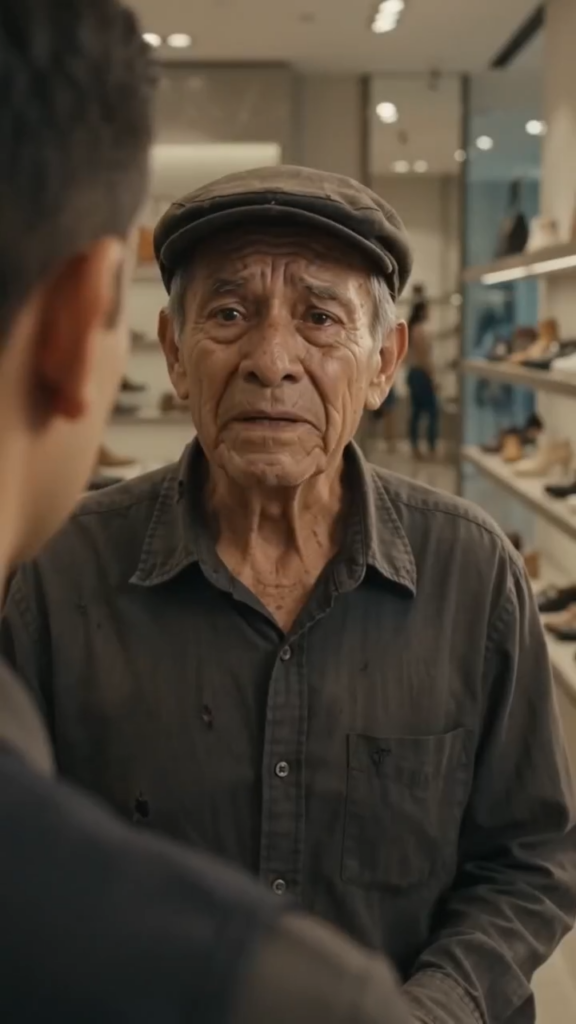
The moment is captured with agonizing, hyper-realistic detail in videoframe_406.png. The contrast between the two men was a masterpiece of social disparity. Tristan, seen from behind, represented the sleek, impenetrable wall of modern corporate luxury. But the focal point of the universe in that second was the old man’s face.
He was a map of a hard, unforgiving life. Deep, canyon-like wrinkles carved through his weathered, sun-beaten skin, telling stories of decades spent laboring in conditions Tristan couldn’t even fathom. He wore a faded, worn-out flat cap that cast a slight shadow over his deeply lined forehead. His shirt—a dark, dusty grey button-down—was frayed at the collar and peppered with small, distinct holes, the fabric thinned by years of relentless washing and wearing.
But it was his eyes that froze the blood in Tristan’s veins.
They were dark, luminous, and brimming with a devastating mixture of profound sorrow, desperate urgency, and a flickering, dangerous resolve. They were not the eyes of a beggar looking for a handout. They were the eyes of a ghost who had finally found his way back to the house that was stolen from him.
His mouth, surrounded by the deep creases of age, was slightly parted, trembling with the weight of words that had been trapped in his throat for half a century.
"I am not lost," the old man said. His voice was raspy, carrying the texture of sandpaper and gravel, but it was remarkably steady. "I have walked five miles this morning. I know exactly where I am."
"Then you know this is private property," Tristan snapped, recovering his arrogant composure. He looked pointedly at the small holes in the man’s shirt. "And you know that there is absolutely nothing in this building that you can afford. Now, leave before I have you arrested for trespassing."
The old man didn’t flinch. He slowly turned his head, his weary eyes scanning the brightly lit boutique, looking past the pristine shelves and the terrified sales associates, until his gaze landed squarely on the center pedestal. He looked at The Valerius Apex boot.
"I didn’t come to buy anything, boy," the old man whispered, his eyes locking onto the leather shoe. "I came to look at my life’s work."
Chapter 3: The Ghost of the Artisan
Tristan let out a short, mocking laugh. "Your life’s work? Are you insane? That boot was designed by my grandfather, Marcus Valerius, in 1974 in a private atelier in Milan. It is the foundation of a two-billion-dollar empire. You belong in a psychiatric ward, old man."
"My name," the old man said, turning his piercing gaze back to Tristan, "is Elias Thorne. And your grandfather didn’t design that boot in Milan. He stole it from a damp, windowless cobblestone workshop in Brooklyn in the winter of 1973."
The silence in the boutique was sudden and absolute. The security guard, who had been advancing to grab Elias by the arm, stopped dead in his tracks. The sales associates exchanged terrified glances.
"Get him out of here," Tristan barked, his face flushing red with a sudden, inexplicable panic. "Now!"
"The stitching on the heel," Elias continued, raising a calloused, trembling hand, ignoring the guard stepping toward him. His voice began to rise, filling the cavernous luxury store. "It’s a double-blind welt. A proprietary stitch that no machine can replicate. It requires a curved needle and exactly twenty-two pounds of tension on the thread. If you apply twenty-three, the leather tears. If you apply twenty-one, the sole separates after six months."
Tristan froze. The color rapidly drained from his face.
The double-blind welt was the absolute, closely guarded secret of Maison de Valerius. It was the mechanical signature of their brand, the reason their shoes lasted a lifetime, and the justification for their astronomical prices. Only three master cobblers in their Italian factory knew how to execute it. It was a corporate secret guarded more fiercely than the Coca-Cola recipe.
There was absolutely no way a destitute old man off the street could know the exact tension weight of the proprietary stitch.
"Who sent you?" Tristan demanded, his voice dropping to a harsh whisper. He stepped closer to Elias, invading his space. "Is this a corporate espionage stunt? Did the Arnault group pay you to come in here and spout this garbage?"
Elias looked at the young, furious heir with a profound sense of pity.
"Nobody sent me," Elias said softly. "I built that stitch because my hands were too crippled with arthritis to hold a standard awl. I had to invent a new way to bind the leather so I could keep feeding my family. Marcus Valerius was my apprentice. I taught him everything. I took him in when he had nothing."
Elias took a slow, labored breath, the memories clearly causing him physical pain.
"I made the prototype for the Apex for a national design competition. The prize money would have paid for my daughter’s leukemia treatment," Elias’s voice cracked, a raw, agonizing sound that cut through the sterile air of the boutique. "But the night before the submission, Marcus broke into my shop. He took the prototype. He took my design journals. He set fire to the workbench to cover his tracks."
Chapter 4: The Original Stitch
Tristan felt a cold sweat break out along his hairline. He wanted to laugh. He wanted to throw the old man onto the street. But the absolute, unwavering conviction in Elias’s eyes—the visceral, hyper-realistic pain captured in videoframe_406.png—was impossible to dismiss as the ramblings of a madman.
"You’re lying," Tristan sneered, though his voice lacked its previous authority. "You have no proof. If my grandfather stole it, why didn’t you go to the police? Why wait fifty years?"
"Because Marcus was smart," Elias said, reaching a shaking hand into the pocket of his worn, dark shirt. "He patented the design under his name the very next morning. When I went to the police, they laughed at me. A poor, uneducated immigrant against a charismatic young businessman with a patent? I had nothing. My shop was burned. And a month later… my daughter died because I couldn’t afford the experimental treatment."
The air in the room felt impossibly heavy. The tragedy of the story was suffocating.
"I spent fifty years in the shadows, Tristan," Elias said, using the heir’s first name, treating him not as a billionaire, but as the grandson of a thief. "I watched your family build an empire of gold on the ashes of my life. I watched you put your name on my soul."
"A tragic story," Tristan said, forcing a cruel, defensive smile. "Truly. You should write a novel. But in the real world, we deal in facts, legalities, and evidence. You have nothing. You are nothing."
Elias slowly pulled his hand out of his pocket. He wasn’t holding a weapon. He wasn’t holding a legal document.
He was holding a single, heavily tarnished brass key, and a small, tightly wrapped bundle of ancient, oiled canvas.
"Marcus burned the shop," Elias whispered, his dark eyes locking onto Tristan’s terrified face. "He stole the right shoe, which was the completed prototype. But he didn’t know that I always crafted the left shoe first. And he didn’t know about the fireproof floor safe beneath my workbench."
Tristan’s breath hitched.
Elias slowly began to unwrap the oiled canvas. The smell of old leather, fifty years of dust, and the unmistakable scent of brilliant, original craftsmanship filled the air, overpowering the boutique’s artificial fragrance.
As the canvas fell away, it revealed a shoe.
It was the left boot of the Valerius Apex. But it wasn’t pristine. It was raw, authentic, and unmistakably older than the brand itself. And stamped into the raw leather of the inner sole, clear as day, was a date—November 12, 1973—and a signature: Elias Thorne.
"Marcus patented the design," Elias said, his voice now ringing with the unstoppable force of a delayed reckoning. "But he made one fatal flaw. To rush the patent, he submitted the exact dimensions and schematics of the right shoe. In patent law, a design must be entirely original. This left shoe, notarized and dated by the cobbler’s guild a month before Marcus even filed his paperwork, proves prior art."
Chapter 5: The Collapse of the House of Valerius
Tristan stared at the boot in the old man’s weathered hands. The world around him began to spin. He was a businessman; he knew exactly what "prior art" meant in the context of intellectual property.
If this boot was authenticated—and the meticulous, undeniable double-blind welt stitching proved it was—every single patent Maison de Valerius held on their flagship designs would be instantly invalidated. The foundation of the company was built on fraud. The lawsuits from shareholders alone would bankrupt them. The scandal would destroy the family name forever.
"You…" Tristan stammered, stepping back, bumping into a glass display case. The facade of the arrogant billionaire was completely shattered. "What do you want? Money? Name your price. Five million? Ten million? I can write you a check right now. You’ll never have to walk five miles again."
Elias Thorne looked at the young man, his deeply lined face captured perfectly in the unyielding gaze of videoframe_406.png. There was no greed in his eyes. There was no desire for the wealth that surrounded him.
"Ten million dollars," Elias whispered, the words tasting like ash in his mouth. "Can ten million dollars buy back fifty years? Can it un-burn my shop? Can it pull my little girl out of the earth?"
Elias stepped closer, holding the original boot like a judge holding a gavel.
"I don’t want your money, Tristan. Your money is cursed. It is stained with the blood of an artisan."
Elias slowly turned toward the massive, floor-to-ceiling glass windows of the boutique, looking out at the bustling, oblivious crowds of Fifth Avenue.
"I contacted a journalist at the New York Times investigative desk this morning," Elias said, his voice calm, resolute, and absolutely terrifying. "I gave them the keys to my safe deposit box, where the original design journals survived the fire. The story goes live on their digital front page in exactly…"
Elias looked at a cheap, battered watch on his wrist.
"…four minutes."
Tristan’s knees gave out. He collapsed onto the pristine Calacatta marble floor, the sharp sound echoing through the dead silence of the luxury boutique. The billionaire empire, built on a lie, was crumbling in real-time, brought down by a man in a torn shirt who simply refused to let the truth die in the dark.
Elias Thorne didn’t look back. He turned around, his scuffed boots leaving a final trail of dirt across the floor, and walked out the heavy glass doors into the sunlight, leaving the House of Valerius to burn to the ground.